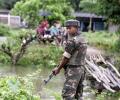
General Officer Commanding-in Chief of the Eastern command, Lieutenant General R P Kalita, however, said the Indian side is also continuously upgrading its infrastructure and capabilities to deal with any situation which may arise along the border.

Why can't the Indian government propose to the Chinese a corridor circumambulating the Holy Mountain where people from both sides could perform the yatra again? asks Claude Arpi.
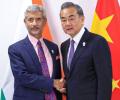
The joint statement said Jaishankar and Wang agreed that both sides should take guidance from the series of consensus reached between leaders of the two countries on developing India-China relations, including not allowing differences to become disputes.

Chief Economic Adviser V Anantha Nageswaran on Wednesday said that the country is not pursuing any proposal to replace the US dollar as international currency for global trade. "No, certainly not. I think India is not part of any such initiative," he said in response to a question if India is looking at an alternative currency to the US dollar for global trade.
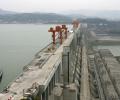
China has approved the construction of the world's largest dam on the Brahmaputra River in Tibet, close to the Indian border. The USD 137 billion project, which is expected to dwarf even China's own Three Gorges Dam, has raised concerns in India and Bangladesh, the downstream riparian states. Concerns in India are centered around China's potential to control water flow, potentially enabling the release of large amounts of water to flood border areas in times of hostilities. The dam is part of China's 14th Five-Year Plan, and the Chinese government claims that the project is safe and prioritizes ecological protection.

Union Home Minister Amit Shah will visit Arunachal Pradesh on April 10 and 11 where he will launch the 'Vibrant Villages Programme' in Kibithoo, a village along the India-China border.

'The amount of respect we have for people who guard our borders and put the country first.' 'Why do they do this?' 'The chances of not coming back are so high. Still, they take that risk.' 'It's for the love of the country.'
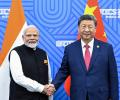
Prime Minister Narendra Modi has emphasized dialogue over discord in India's relationship with China, acknowledging natural differences between the two countries but stressing that stronger cooperation is essential for their mutual interests and global stability. In a podcast with Lex Fridman, Modi highlighted the ongoing efforts to restore normalcy along the border following the 2020 clashes, emphasizing the importance of a stable and cooperative relationship.

The destabilising and corrosive behaviour of the Chinese Community Party in the Indo-Pacific region is simply not helpful and some of the defence infrastructure that is being set up by China near its border with India is alarming, US Army's Pacific Commanding General Charles A Flynn said on Wednesday.

India emerged from the war militarily bruised and strategically altered. The United States, under the guise of friendship, had succeeded in achieving what open alignment never could: The psychological and political repositioning of India within the Cold War order, points out Dr Kumar.
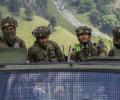
Two days after the India-China military talks, the joint statement, issued in New Delhi by the Indian Army said both sides had a 'candid and in-depth exchange' relating to disengagement along the Line of Actual Control (LAC) in the Western Sector of India-China border areas.
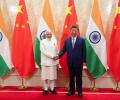
Prime Minister Narendra Modi and Chinese President Xi Jinping held bilateral talks focusing on economic ties and global stability amid trade tensions and the aftermath of the Ladakh border row.
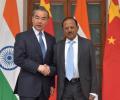
The two sides have already held 21 rounds of talks under the framework of SR dialogue which was set up to find an early solution to the border dispute.

India will look at disengagement and de-escalation of the situation along the Line of Actual Control (LAC) in eastern Ladakh after restoration of the status quo of April 2020, Army Chief General Upendra Dwivedi said on Tuesday, a day after New Delhi announced striking an agreement with Beijing to end the over four-year border row in the region.

The Global Times, a prominent state-run Chinese media outlet, published an article titled "China and India are cooperation partners, not rivals: Xi," highlighting President Xi Jinping's remarks about the bilateral meeting, saying, "as long as the two countries stick to this overarching direction, China-India relations can sustain steady and long-term growth."

In their first structured bilateral talks in nearly five years, Prime Minister Narendra Modi and Chinese President Xi Jinping Wednesday agreed that India and China can have a 'peaceful and stable' relationship by displaying maturity and mutual respect and endorsed the pact on the resolution of the dragging eastern Ladakh border row.

Defence Minister Rajnath Singh on Thursday held talks with his Chinese counterpart Li Shangfu and is learnt to have discussed the lingering border row in eastern Ladakh.
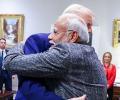
One must wonder whether Mr Modi's efforts to wine and dine the Big Two of today's world were seen as a sign of weakness rather than a proffered arm of friendship, points out R Jagannathan.

The Chinese see no need to fight directly. They have an able and willing proxy in Pakistan, points out Shekhar Gupta.

Situated at a height of 15,200 feet above sea level, the pass sits on the top of a craggily formed Himalayan range that separates the Tibetan plateau from the Indian sub-continent.
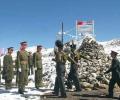
The comments came in the backdrop of the continuing standoff between the militaries of India and China at the LAC.

External Affairs Ministry Spokesperson Anurag Srivastava said the diplomatic and military talks have helped both sides to enhance understanding of each other's positions on the issue.
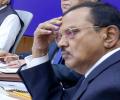
National Security Advisor Ajit Doval arrived in Beijing on Tuesday to take part in the India-China Special Representatives' talks to be held on Wednesday aimed at restoring the bilateral ties stalled for over four years' due to the military standoff in eastern Ladakh.

If Beijing succeeds in this multipronged effort to challenge the current dominant power, it will have not just economic but political and security consequences. There is no let-up in the South China Sea nor any de-escalation moves on the India-China border. This portends to ominous signalling from Beijing, observes China expert Srikanth Kondapalli.
'If the Trump administration could gain access to the nuclear weapons, they would be satisfied -- at least they could control them.'

The external affairs ministry said the talks were 'positive'.
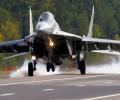
The Indian Air Force carried out intensive night operations involving its fighter aircraft including the MiG-29 and Sukhoi-30MKI along with its Apache attack helicopters and the Chinook heavy-lift helicopters.
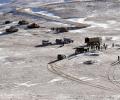
Both countries have reached a mutual agreement for disengagement of troops from the most contentious area of North and South Pangong Lake.

External Affairs Minister S Jaishankar on Saturday credited the breakthrough agreement with China on patrolling along the Line of Actual Control to the military which worked in 'very very unimaginable' conditions and deft diplomacy.
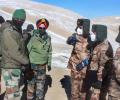
India and China on Tuesday agreed to hold the next round of the Senior Commanders meeting at an early date to achieve complete disengagement from all friction points in eastern Ladakh to create conditions for the restoration of normalcy in bilateral ties.
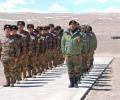
The talks till now have resulted in the resolution of issues in North and South Bank of Pangong Tso, Galwan and Gogra Hot Spring areas.
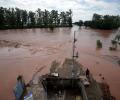
Pakistan has urged India to fully adhere to the Indus Water Treaty (IWT), expressing concerns about the level of detail in flood information shared through diplomatic channels.

'My father's life sends a message that there are positive things happening between India and China, no matter what happens at the border.'
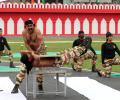
The 62nd Raising Day of the Indo-Tibetan Border Police Force was commemorated with great enthusiasm at the Seema Dwar in Dehradun.

The BRICS nations have expressed concern over the proliferation of trade-restrictive actions in the form of 'indiscriminate rising' of tariffs, particularly measures used as a means of 'coercion', cautioning that such practices risk marginalising the Global South countries.
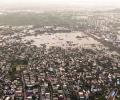
How the UN's flagship climate summit lost its direction and what's at stake.
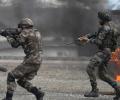
'Post the pandemic, when India is turning a new leaf in its economic policy with an eye on foreign capital and global supply chains that are likely to leave China, heightened tensions on the India-China border creates an atmosphere of uncertainty,' observes Virendra Kapoor.
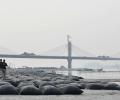
China has formally started the construction of a USD 167.8 billion dam over the Brahmaputra River in Tibet, close to the Indian border in Arunachal Pradesh, raising concerns in India and Bangladesh.
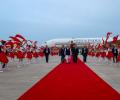
Prime Minister Narendra Modi arrived in China for the Shanghai Cooperation Organisation (SCO) summit. His meeting with President Xi Jinping is significant given global economic concerns.
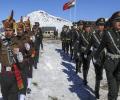
India and China on Thursday agreed to hold the next round of military talks at an early date to achieve the objective of complete disengagement in remaining friction points in eastern Ladakh.
